Monday, 27 May 2019

"The water that is past.."


Recently I've been reading some of the work of Katrina Porteous, a poet who writes a lot about changing landscapes and vanishing communities. So it was interesting last week to visit Clencher's Water Mill on the Eastnor Estate near Ledbury, on a workshop organised by the Ledbury Poetry Festival. It's one of a series of mills that stood along the Glynch Brook and it milled flour for almost two and a half centuries before becoming redundant in 1939. Now it's been restored to full working order and we were shown around by a real enthusiast, who demonstrated the milling process and explained the technicalities.

What struck me very forcibly on the visit was the language of the mill, the words and phrases that must have been in common use in our great-grandparent's day but that are quite foreign to our generation - wallowers, brayers, layshafts, tuns, many more. Although I've written before about the tragedy of a language loss when a community becomes displaced or dies out, I hadn't paid a great deal of attention to the importance of individual words and their associations - some real food for thought there (and material for more than one poem).

In the afternoon we had a walk on the Malvern Hills, the stamping ground of much of my childhood and adolescence. It was interesting to hear the variety of poems that came out of the group's short time there - again a lot focusing on the history of the hills, the lives of the people who have lived, worked and walked on them over the centuries. Perhaps you'd like to hear them too - Jean Aitken, the "Troubadour of the Hills", will be launching a celebration of them at the Ledbury Poetry Festival in six weeks time; do join us for a poetry breakfast under the Market House, 09.30 - 10.30 on Sunday July 7th. Coffee and croissants included!

Friday, 17 May 2019

Mental Health Awareness Week


Commemorating a journey of creativity 

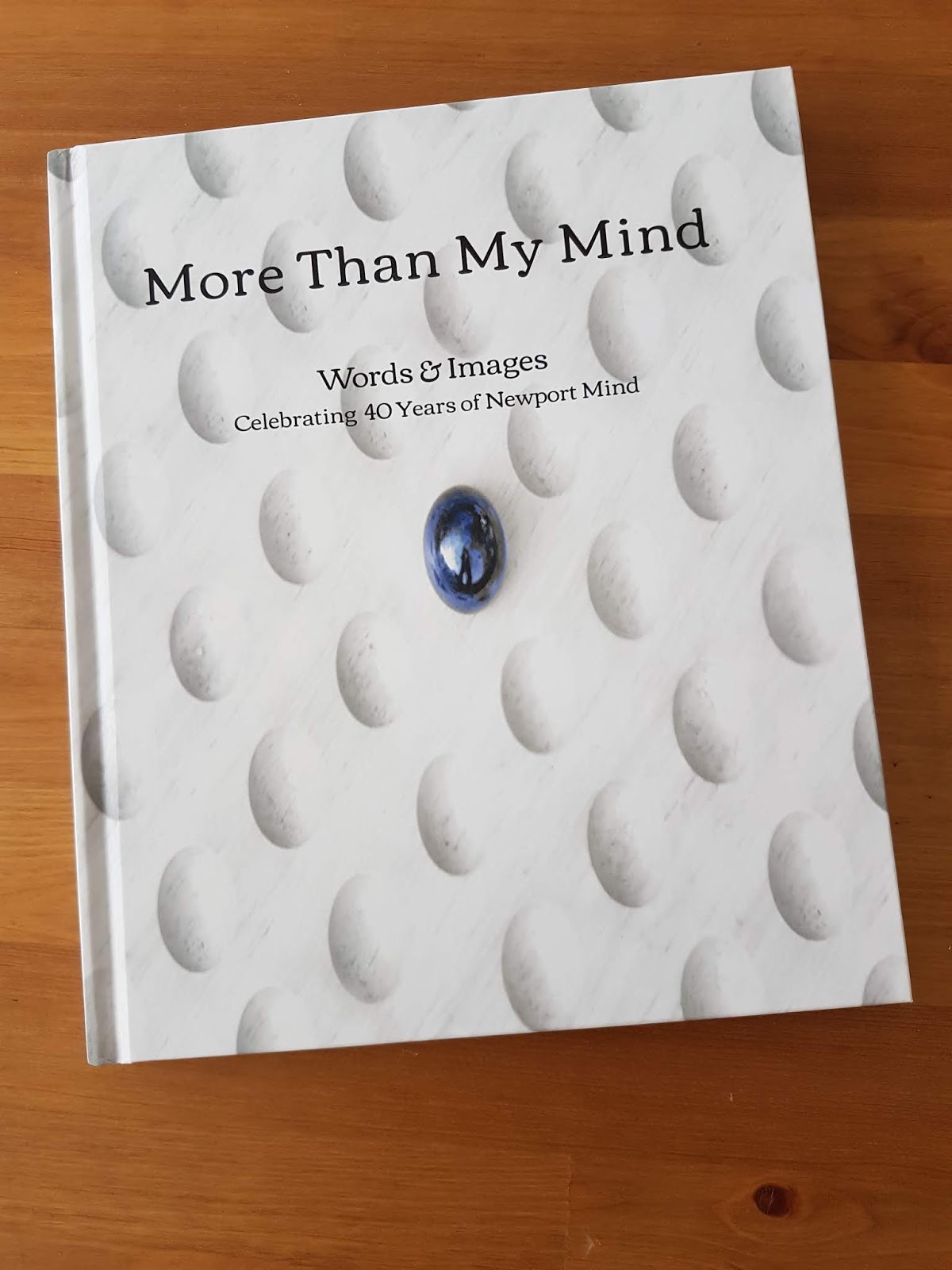
How appropriate that my guests on The Writer's Room broadcast this week should be members of the creative writing group at Newport MIND - it was a great way to mark Mental Health Awareness Week, to celebrate their writing and to give some publicity to the anthology "More Than My Mind" which they produced last year to mark 40 years of Newport's branch of the organisation. On the programme, along with their facilitator Helen McSherry, they read extracts from the book and other work and talked about their lives and their experiences of mental health problems; they spoke eloquently of the value they placed on the group itself and on the power of creative writing to help overcome problems that they faced.

The group's anthology came about through collaboration with a renowned Newport poet, Paul Chambers, and a National Geographic photographer, Daniel Alford. Some of the poems within it were written by members of other organisations the group connected with, including Age Alive, a Black and Minority Ethnic organisation. Under Daniel's tuition, the MIND Photography Group produced superb photos to complement the writing and the hard back book is really beautifully presented. Copies are for sale through Newport MIND and they're also available at the Riverfront Arts Centre in Newport - they're well worth a look at.

Helen McSherry with Giles Hibberd, Patrick Jeremy,
Mark Haines, Eamon Sweeny and Mark Vrettos


Wednesday, 8 May 2019

Poems and places


Women Aloud
Judith van Djikhausen, Christine Griffin, Gill Garrett,
Belinda Rimmer, Frances March, Angela France.

Last week was "one of those weeks" - when your feet hardly touch the ground and you skid from one thing to another. All enjoyable activities but no time to process what's going on and quite exhausting!

The Cheltenham Poetry Festival was as fantastic as ever, with a hugely varied programme and some tremendous poets participating. Women Aloud, the group I so value belonging to, started off the Sunday afternoon activities and we had a great, very appreciative audience. We were followed by Duncan Forbes and Ann Drysdale; Ann launched her latest publication Vanitas (Shoestring Press) last week and that's really worth investing in. My Catchword colleague Derek Healy was up next with Roy Marshall and Steve Walter; as ever I loved hearing his work, especially the poems from his collection "Made Strange By Time".  And it was back to Cheltenham on Wednesday to read with the Poetry Festival Players.  Our theme this year was "Water" and the programme encompassed  poets and topics from Shakespeare to Alison Brackenbury, The Lady of Shalott to the floods of 1947 and viewing the Severn Bore.

Then activities of a very different nature over the weekend; a Welsh learners course at Glan Llyn, the youth centre on Llyn Tegid. The saying goes of course that to be Welsh is to have poetry in your blood and music in your heart. There was certainly plenty of music, both on site and at the local pub. On Saturday morning we visited Yr Ysgwrn, home of Hedd Wynn, the shepherd poet whose poem was announced as the winner at the 1917 Eisteddfod before it was realised that he had been killed at Passchendaele six weeks beforehand. The "Black Chair" - the chair that had been draped in black as the Archdruid spoke of "the festival in tears and the poet in his grave" - is prominently on display in the house. I had visited and seen the chair a few years ago but the story bears telling many times over and the experience this time was just as poignant.

North Wales was beautiful in the spring sunshine and as inspirational as ever. There is so much history in its industrial landscapes, its towering mountains, its deep cut valleys. No wonder it has generated such a plethora of literature and poetry. This time I was very aware of the sadnesses, the injustices in much of that history, especially when standing by Llyn Celyn in the Tryweryn Valley, created by drowning the village of Capel Celyn in 1965 to provide a reservoir to supply Liverpool. Beneath the now peaceful waters lie 800 acres of land, the homes of forty eight people, a school, the chapel, post office, a Quaker Meeting House and its cemetery; the protests of every single Welsh MP, every member of its small Welsh speaking community and their neighbours could not save the village from destruction. "Cofiowch Dryweryn" (Remember Tryweryn) wrote the singer-songwriter Meic Stevens, a sentiment echoed around Wales; how much today we need to remember - and to act on that remembering - with so called "progress" threatening ever more communities and their ways of life.

Llyn Celyn


Monday, 22 April 2019

Back in harness

Not a great month with health and family issues (hence the long gap) but life is back on as even a keel as it can be - and summer appears to have overtaken spring. I can't remember so hot and sunny a Bank Holiday weekend; I do hope everyone's making the most of it. I'm now way behind on a couple of deadlines but I've taken a few days out to enjoy things - then it's back to the desk with a vengeance tomorrow!

It's certainly hard to think that we only recently had to postpone a Writer's Room broadcast because of thick snow. But last Thursday saw us not only back in harness at NHSound, but also in our brand new studio in Tredegar. There were the inevitable teething problems with the technology of course, but overall it was a good start and an interesting morning; the programme had a "Tales from Wales" theme and we had three guests making very different contributions. Peter Dimery from Caldicot Writers spoke about his Pembrokeshire stories which are currently in preparation and we heard two from the series. Valerie Thompson and Nigel Daft both belong to Cwmbran Writers. Valerie's memoir of life as a small child in a Welsh village spoke, I'm sure, to a whole generation who grew up "up the Valleys" in the early post-war days; for something completely different we then turned to Nigel's "Tin Dog" series of books which feature a robotic canine faced with the bewildering scenarios of everyday life in South Wales. I'm still smiling at the description of a game of snooker!


Valerie Thompson
Nigel Daft


Peter Dimery

Sunday, 24 March 2019

Joining forces


Last Thursday, March 21st, was World Poetry Day. Every culture on every continent has its own poetic tradition and it was great to see the day marked in countries all around the globe, and in so many different ways. Our own contribution to the celebrations brought two excellent local poets, Su King and Alyson Rees, in to the studio for The Writer's Room. Alyson was a returning guest on NHSound; a relative newcomer to the poetry scene, she has enjoyed considerable success in recent months and it was lovely to hear some of her new work. It was Su's first visit to us; she's a very accomplished performance poet and had us in stitches with her take on everything from hot flushes to seaside trips with Sunday School via the trials of looking after a demanding post-operative husband. As we discussed, in poetry nothing is off limits!

Alyson Rees
Su King

And yesterday I joined forces with a million other marchers from all around the UK. The People's Vote march has to be the biggest, friendliest, most orderly protest I've ever been on. It was a privilege to be there. Whilst I could wish it hadn't been necessary, in the circumstances I wouldn't have been anywhere else.

And it's for his generation
we needed to do it

Wednesday, 20 March 2019

Learning from the masters


An interesting afternoon on Sunday at the National Museum and Art Gallery in Cardiff, where there's currently the Leonardo da Vinci, A Life in Drawing exhibition. I'm always amazed by the power artefacts from hundreds of years ago can have over me, the strange bond they establish with the long dead of vastly different ages and cultures, the acknowledgement of the common human concerns and aspirations across the centuries - and what we can learn from them.

Unfortunately, time didn't allow a long visit (though I'll certainly be back); but two things struck me very forcibly. The first was the diligence in preparation for projects, the tremendous amount of time and effort expended studying the minutiae of the subject matter before getting anywhere near execution. The second was the fact that nothing is wasted; da Vinci spent ten years preparing for a huge equine monument project only for it to be abandoned at the last moment, but the sketches and models he had made were fundamental to other, later creations as well as being works of art in themselves. Certainly a couple of lessons there for anyone in the creative arts!


Friday, 8 March 2019

International Women's Day

I think it was Antony Sher who once said "Nothing is more interesting than human lives". I have an enduring passion for biographies and autobiographies; I'm enthralled by entering into another's world, seeing things from their perspective, going to places I shall probably never visit but experiencing them in another's shoes.

Looking through the books on my shelves, I'm very aware that most of the lives I read about are women's lives. So many of the best sellers, the supposedly "serious" biographies are of course about men, about the great and the good (or the not so good!) who have had major impacts on national or international situations. Women's lives, with notable exceptions, have so often been more private, often family centred affairs - more challenging to write about when there are fewer written or other sources from which to glean information. But I think it's this combination of the private and the public, the ability of the subjects to function on different levels in different capacities, that really interests me. Women's lives are often infinitely more complex than those of their male counterparts, and therefore, to me, richer to explore.

It was heartening to see the emergence of more "women focused" books during the recent commemorations of the First World War, with the vital roles women played at last receiving due recognition. And not just the famous ones - the likes of Vera Britten and Elsie Inglis - but the local, unsung heroines in towns and villages who nursed the sick, harvested the fields, manned the trams and stretched the meagre food supplies. Their more prominent sisters may be honoured on plaques and memorials but those stand as reminders too of all the women's contribution in such  desperate times.

The theme of this year's International Women's Day is "Think equal. Build smart. Innovate for change" - today's language perhaps, but those three principles were precisely those that motivated our predecessors a hundred years ago. In Newport earlier this week I was reminded of the women of my own home town to whom we owe so much. A mural in Commercial Street, unveiled during the WW1 commemorations, stands witness to their lives - all those who paved the way for the daughters and granddaughters coming after them, who had and have hugely greater freedoms and opportunities because of those women's stands.

The Newport mural followed from the publication of Sylvia Mason's book "Every Woman Remembered - Daughters of Newport in the Great War". The book not only recounts the lives of the seven women who died after "active" war service but pays due homage to the many others, my own grandmothers among them, to whom we owe so much. And it's far from a "trip down memory lane" - it all has direct relevance to what's going on in the contemporary world. The proceeds from the sale of the book (available from Amazon and Saron Publishers) go to Newport Women's Bursary which awards funds to help local women fulfill their ambitions today.

Our current concerns may not be those of previous generations but, as the saying goes, "you can only understand the present in the light of the past" - acknowledging it and learning from it goes a long way towards helping us into the future!